


I started at a new desk, seven days ago. Everything about the move was well considered — the market, the company and the reasons. What I hadn’t thought about at all was what I’d actually be measuring myself against on a random Tuesday morning.
I watched a short clip from Saleem Asaria on Instagram, who’s spent 30 years in behavioural healthcare, and he named the gap precisely.
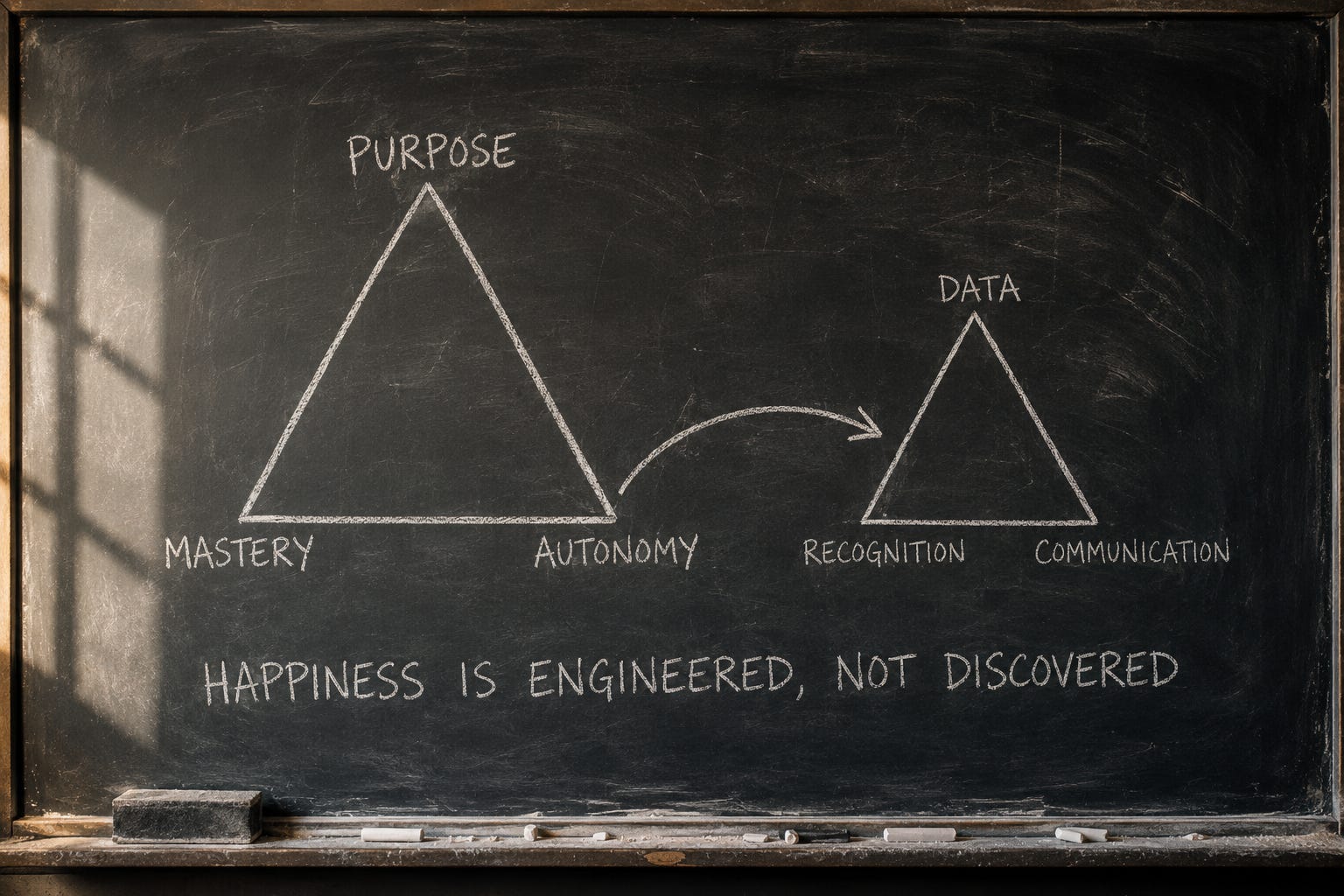
Two Triangles
His argument is that the people who seem to have it sorted aren’t chasing happiness. They’ve built a life that can’t sustain unhappiness.
Triangle one: Purpose. Mastery. Autonomy.
Triangle two: Autonomy, broken into its working parts — Data. Recognition. Communication.
His example is in the eyes of Fitbit:
Purpose: don’t be sedentary.
Mastery: 10,000 steps.
Autonomy: the data sits on your wrist, so you never have to ask anyone how you’re going.
Then recognition and communication, which he says is the part we all need and most of us won’t admit to.
His mother is 86 and lives with interstitial lung disease. When she’s 200 steps short at the end of the day, she walks the stairs. Not for the steps. Because she knows that the moment the number ticks over, her grandchildren, her nieces and her nephews will ring and tell her well done.
The Fitbit didn’t motivate her. The loop did.
Where I was thin
Test yourself against the six points honestly and you find out fast which one you’ve been coasting on.
Purpose was fine. I knew exactly why I made the move. Autonomy is arguably better than it’s ever been — I can see my own pipeline, I don’t need anyone’s permission to know where I stand. Recognition sorts itself out over time; it’s slower at a new firm, but it’s a function of results, not a thing to engineer.
Mastery was the hole. And it’s the sneaky one, because from the outside a busy calendar looks identical to a measurable standard.
I had activity. Meetings, inspections, appraisals, calls. What I didn’t have was a number I could fail against by Friday. Something I either hit or didn’t, that I could see without opening a report someone else wrote. In a transaction business the natural metric is settled deals, and settled deals are a terrible daily standard — they’re lagging, lumpy, and mostly determined by decisions made months earlier. You can have a fantastic quarter of work and a blank month of outcomes.
That’s not a measurement problem. It’s a design problem.
Why it matters more than motivation
Motivation is a feeling, and feelings are circumstantial. They’re highest in the first fortnight of anything and lowest in the middle, which is exactly when the work matters.
A system doesn’t care how you feel. Clear purpose, a standard you either meet or miss, data you can see without asking, and someone who registers the win — that structure holds weight on the days you’d rather not.
Most people, me included on this occasion, run the opposite way. We optimise the visible stuff — the title, the platform, the market — and assume the daily architecture will assemble itself. It doesn’t. You end up with a genuinely good decision and no way of knowing, on any given Tuesday, whether you’re executing it well.
The correction
The good news about a design problem is that it’s fixable in an afternoon.
I’ve set a leading standard. Not deals. Something I control entirely, that I can count before lunch, that says nothing at all about whether the market cooperated this month. A standard you can only hit when conditions are favourable isn’t a standard — it’s weather.
What surprised me is how much lighter it made everything. The pressure in a transaction business isn’t the work; it’s the not-knowing. Am I actually building something this week, or just busy? Give yourself a number you can meet by Friday and that question stops running in the background. The deals still take as long as they take. You’re just no longer waiting on them to tell you whether you’re doing the job well.
Asaria’s conclusion after three decades in behavioural health is that happiness is engineered, not discovered. I’d extend it. So is a career. The move was the easy part — and the far better part is that the rest is entirely in your hands.
Run yourself against the six points. Whichever one’s thin, it’s usually a smaller build than you’d expect, and the payoff is immediate.
Remember;
“Happiness is engineered not discovered.”
Source: Saleem Asaria (@saleem_asaria)
Mastery being the hole is a good catch. A busy calendar really does look like progress until you try to name the number you either hit or missed by Friday. Good luck at the new desk.