



Everyone I know has AI on their phone.
Ask how they use it and the answers get short. A quick email. A caption. A recipe once.
That’s the contradiction at the centre of a16z’s latest State of Markets II deck. Ninety pages on the biggest investment boom of our lifetime. Tucked inside is a slide that says, more or less, most people haven’t really started.
a16z calls it “wide and shallow”.
Wide, not deep
The headline numbers are huge. a16z describes AI revenue growth as unprecedented for speed and scale. Hyperscalers keep saying demand outpaces supply.
Then the deck turns around and says this: “AI adoption is broad and impactful, but still relatively shallow”.
Both things are true at once. Almost everyone has tried it. Very few have built it into how they actually work.
a16z goes further. The impressive aggregate picture, it says, “obscures what is going on beneath the surface”. Growth is “driven by a tiny share of power-users, who are unlocking more value with increasingly sophisticated tools”.
And then the line that stopped me: “all of this is driven by just the top 1% of users, who are only beginning to scratch the surface of what’s possible”.
One per cent.
The gap is getting wider
You’d expect a gap like that to close as the tools get easier. It isn’t closing.
a16z’s slide on power users says “a tiny fraction are using orders of magnitude more AI than the field, and the gap has been widening since early this year”.
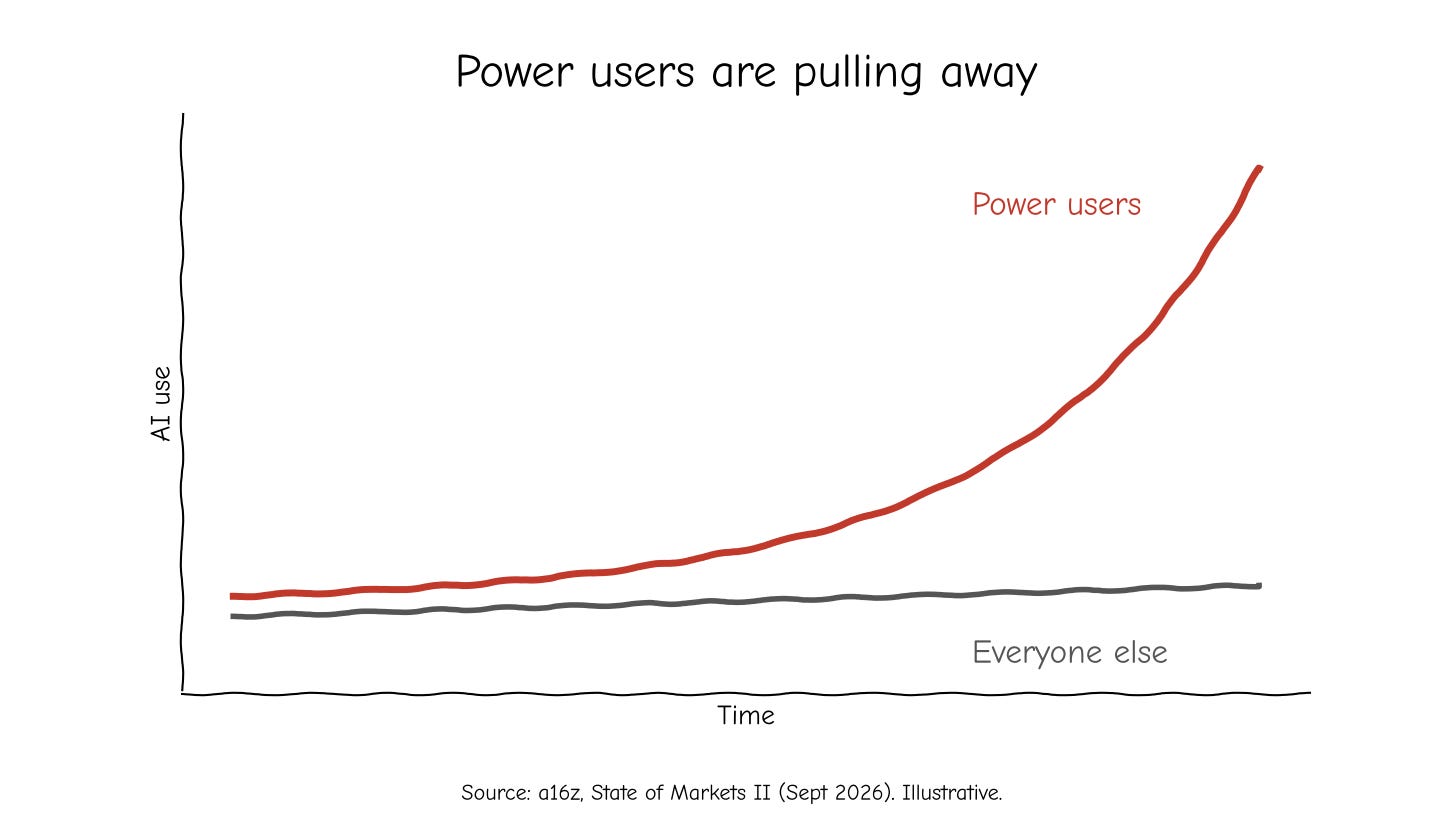
So the people already ahead are pulling further ahead. Not because they have better tools. Everyone has the same tools. They’re just using them more, and more seriously.
That’s the part I find uncomfortable. Access isn’t the advantage any more. Habit is.
Cheap doesn’t mean used
The price of intelligence keeps falling. a16z calls what happens next Jevons Paradox: cheaper intelligence, more demand. It says cheaper tokens have “ushered in the age of agents”.
But cheaper only creates more demand among the people already leaning in. Everyone else gets a cheaper thing they still don’t use.
It’s like a gym membership. Lowering the price doesn’t make anyone fitter. It just means more people own a card.
Even businesses are barely in
This isn’t only about individuals. a16z says most companies “are not cost-constrained, and intend to spend more on AI”. Money isn’t the blocker.
And they’ve barely started spending. a16z points out that cloud reached about 4 per cent of IT spend in its second year, and most AI spend estimates are below that.
So the businesses aren’t short of budget. They’re short of depth.
What the few are getting
Where AI is used properly, the deck shows what it’s worth. a16z collects a page of results directly from the company. Walmart’s chief executive said customers who use its shopping assistant spend 40 per cent more per order than those who don’t.
That’s what deep use looks like. Not a party trick. A behaviour change that shows up in the numbers.
There’s even a real estate example. a16z describes EliseAI, which works with renters and owners and tests regional accents on its AI calls. The idea was that people are more likely to transact with someone who sounds like them, so local voices should lift lead-to-tour conversion. a16z’s note on this kind of gain is honest: the benefits are often “incremental at the margins”, but they “have a tendency to add up to something quite substantial”.
Small, repeated, compounding. That’s how the top 1% got there.
Where I see it
I work in property and hotels transactions. It’s a relationship business. Much of it still runs on phone calls, inspections, and paperwork.
Which makes it a perfect example of wide and shallow. Most people in the industry I talk to have tried AI. Far fewer have changed a single workflow because of it.
Most agents I know use AI. Watch how and you’ll see the problem.
A loose prompt for some marketing copy. Or a spreadsheet with fifteen inputs nobody understands, when the manual version only needed five. That’s not leverage. That’s shallow use dressed up as progress. And it didn’t unlock value.
The easy wins are sitting in plain sight. Documentation. Copying and pasting the same details into agency agreements and confidentiality agreements, over and over.
But the real win is bigger. Pull several sources of information into one workflow. Do it once, properly. Then give that time back to everyone in the team.
I don’t think that’s a criticism of anyone. It’s an opening that will let teams focus on more meaningful work.
Why shallow is good news
If adoption were deep already, the advantage would be gone. Everyone would be operating at the same level. You’d be competing on the same playing field with the same tools.
Shallow means the field is still wide open.
a16z’s own conclusion is blunt. Eventually, it says, “the rest of the market will catch on (or else be left behind)”.
Being early used to mean having the tool first. Now everyone has the tool on day one. Being early means using it properly before everyone else does.
The takeaway
Having AI is not the same as using it. Almost everyone has the first. Almost nobody has the second.
So don’t measure yourself by whether you’ve tried it. Measure yourself by whether anything in your week works differently because of it.
Pick one task you do every week. Use AI on it properly, every time, for a month. Not once. Every time.
That’s how the 1% started.
Access is free. Depth is the edge.
Sources: Andreessen Horowitz, a16z State of Markets II (September 2026), full deck. AI results quoted from company earnings releases as compiled by a16z, including Walmart (John Furner, President and CEO, Q2 FY27 earnings call, August 2026).